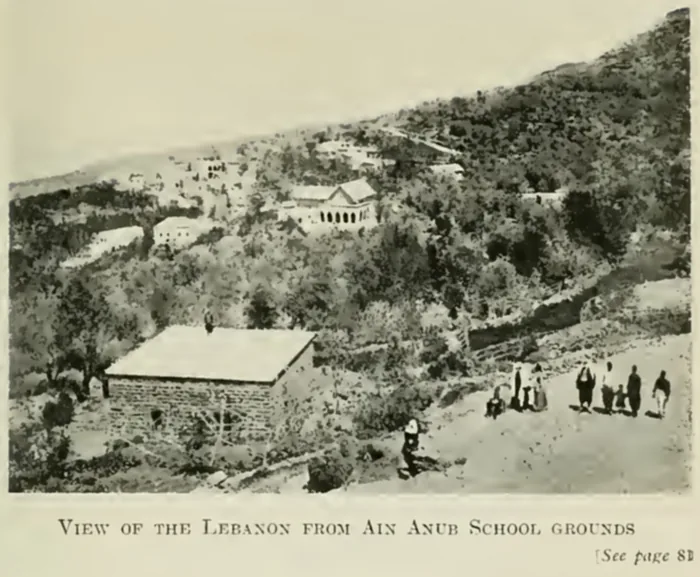
Ain Anub is a village in the Aley District of Mount Lebanon. On the estate now called Qasr Noun, a carved lintel reads AD. 1895. In the autumn of 1907 Canon Joseph Parfit opened a school in its half-ruined buildings. By 1914 it had over 150 pupils and, by his account, the Ottoman Empire's first Boy Scouts.
This is the history of one hill in Ain Anub, told from two kinds of evidence: a date cut into stone, and a book printed in London in 1917. Where the book speaks, we quote it. Where it is silent, so are we. The place itself is Qasr Noun.
A lintel that says 1895
Over one doorway on the estate, a stone lintel carries a date. On the left, in Latin letters: AD. 1895. In the centre, a carved cross. On the right, the same year in Arabic numerals: ١٨٩٥.
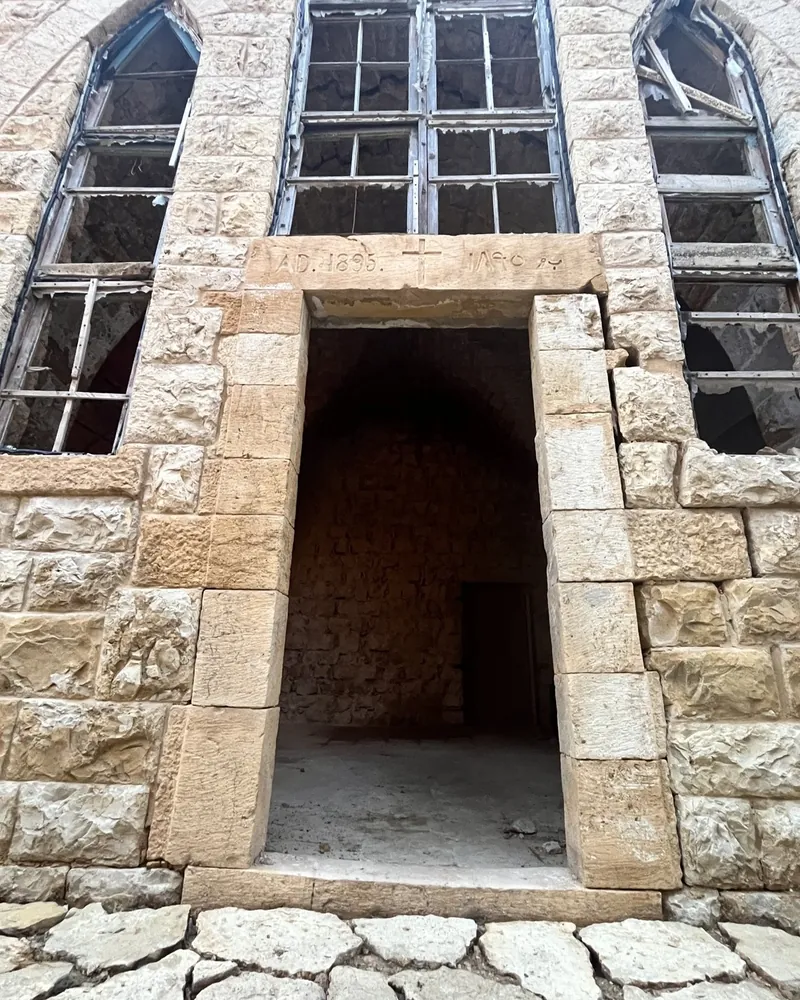
It is the oldest date on the property, and the only one written by the building itself. Everything else in this story comes from Among the Druzes of Lebanon and Bashan, published by Hunter & Longhurst in 1917. Its author was Joseph T. Parfit. The title page names him chaplain in Beirut and Lebanon, and Canon of St. George's, Jerusalem.
The lintel and the book are separate witnesses, twelve years apart. We keep them that way. Parfit does not mention the carving, and the stone does not mention Parfit.
Ain Anub, seat of the Emir Erslan
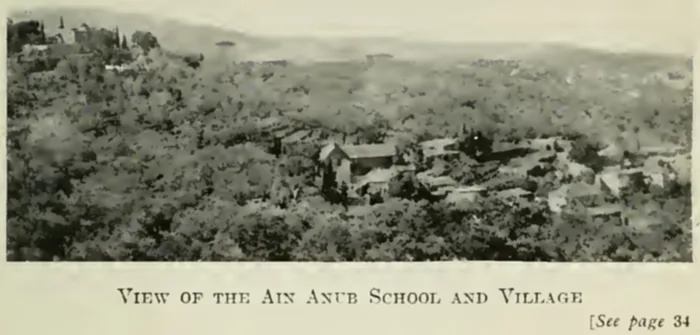
Parfit's third chapter is called “A Ruin Restored.” It opens with the village.
“The village of Ain Anub is an important Druze centre containing the headquarters of the powerful Emir Erslan.”Canon J. T. Parfit, 1917, p. 33
Erslan is his spelling of Arslan. In the next sentence he gives the setting: Ain Anub is “beautifully situated, nearly 2000 feet high, on the Lebanon hills, overlooking the city of Beyrout and the Mediterranean Sea.” That height is Parfit's figure, from 1917. We have not taken a reading on the estate, so we leave it in his words.
Mrs. Worsley and the coachman
Before it was a school, it was a home. The buildings, Parfit writes, “had belonged to a brilliantly clever but eccentric lady, Mrs. Worsley, sister of the famous Bishop Gray of Cape Town.” She had, in his words, “obstinately dragged her devoted husband from their comfortable home in England in order to search amongst the Druzes for the descendants of the Hittites.”
She bought land in Ain Anub and built “a most substantial house” for the two of them. At the other end of the property, near the village, she kept “a boarding school for baptised Druze girls.”
Her furniture came from England “in a huge pantechnicon,” a horse-drawn removal wagon. Getting it up the mountain produced the best sentence in the chapter.
“A special jetty had to be erected at Beyrout for landing this extraordinary waggon, and for three days fourteen mules were employed to drag this heavy, cumbersome vehicle along the nine miles of winding roads that mount the Lebanon slopes, from Beyrout to Ain Anub.”Canon J. T. Parfit, 1917, p. 35
Parfit found what was left of it in the school grounds seventeen years after it arrived. Sold at auction with the rubbish, “this wonderful waggon fetched only 10s. 9d.”
Mrs. Worsley was “stone deaf and was never able to learn the Arabic language,” so she “entrusted everything to the care of an English coachman.” When she died, the rooms “had been locked up and sealed by Consular authority.” For seven winters, by Parfit's account, rain came through the neglected mud roofs onto the furniture.
Then the will. “Mrs. Worsley had foolishly left the whole of her property, worth about £20,000, to her coachman.” Her heirs disputed it, and the case ran in the English courts for about seven years. Meanwhile the estate was, in Parfit's phrase, “rapidly falling to ruin.”
Autumn 1907: Canon Parfit and the ruin
“When I paid my first visit to the village in 1907, I took possession of two sets of buildings that were rapidly going to ruin.”Canon J. T. Parfit, 1917, p. 33
“In the autumn of 1907 I opened a small school and commenced to repair the neglected buildings.” The repairs read like a builder's notebook. Mrs. Worsley's house was altered into a boarding school. “The stables and coach-house were transformed into three classrooms.” Two concrete cisterns were sunk into the hillside, and an assembly room was built over them. The rock dug out for the cisterns went into a larger playground. Terraces were repaired, roads made, trees planted, pumps installed.
By the time war broke out, he wrote, “the half-ruined Worsley estate at Ain Anub was becoming one of the brightest spots in the Lebanon.”
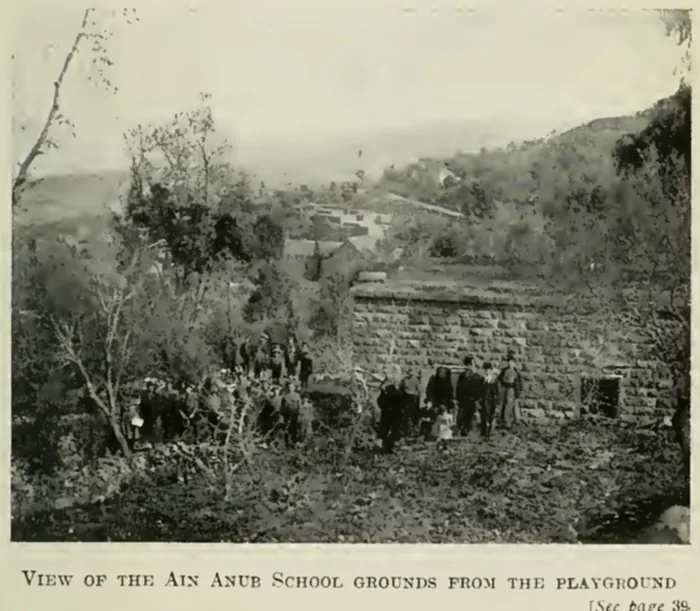
The Ain Anub High School: over 150 pupils by 1914
The small school grew. “In 1914 there were over 150 pupils in the three departments of the institution at Ain Anub.” In less than five years, Parfit writes, there was “a flourishing High School at Ain Anub as the centre of an extensive educational work, and twenty-three village schools under our care with over a thousand pupils.”
Canon S. Campbell, founder of the Hosanna League, which took responsibility for the village schools, counted the growth another way. When Parfit began, there were seventeen children at the school. Four years on, “the seventeen children had grown to 351, the one school had become six.”
Parfit does not rank his school against others. The nearest thing to a verdict comes from a visitor, Arthur W. Sutton, who drove up from Beirut with his daughter and wrote to Canon Campbell afterwards. Beshimoon, in his letter, is Parfit's spelling of neighbouring Bchamoun.
“the most excellent school work I saw at Ain Anub and Beshimoon.”Arthur W. Sutton, letter quoted in Parfit, 1917, p. 168
The first corps of Boy Scouts in the Ottoman Empire
One plate in the book shows a squad of boys in broad hats and scout uniform, marching past a stone wall. Its printed caption makes a large claim: “The first corps of boy scouts in the Turkish Empire.”
Parfit explains that the photograph “was not taken in England, though it might well be mistaken for a photograph of a squad of English Boy Scouts. The lads were, in fact, all Turkish subjects, and most of them were Druzes.” Their scout-master was Mr. Merry, the English master at the High School. Parfit credits him with drilling a squad “which was the first, and at that time the only squad of Boy Scouts to be found in the Ottoman Empire.” (pp. 166 to 168)
Sutton had been told about them before he came, and still did not expect “such a fine troop of thirty to forty lads.”
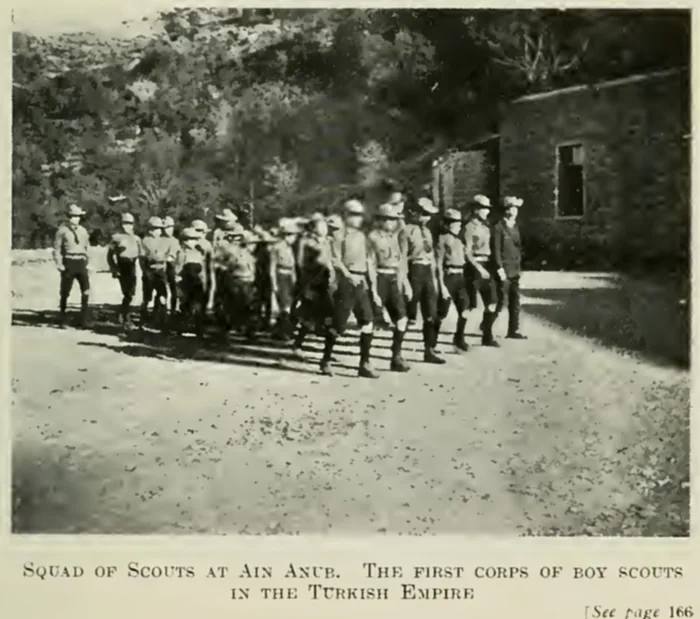
That is Parfit's claim, and we print it as his. Lebanon's own scouting history counts differently. The Lebanese Scouting Federation's history dates the first troop in Lebanon to 1912, founded by two teachers at the school owned by Toufik El Hibri in Beirut. Parfit's book gives no founding year for the Ain Anub squad. The two claims sit side by side, and neither source settles the other.
The Bishop of London among the Druze
The book's ninth chapter records the school's largest day. The Bishop of London, Dr. Ingram, came up the mountain on 22 March 1912, at the end of a tour through Egypt, the Sudan and Palestine. So the Ain Anub scouts were already formed by March 1912, the year to which Beirut's first troop is dated. “A motor-car was sent to meet the Bishop at the Aley station of the Damascus Railway.” At the school gates, the scouts formed a guard of honour. (p. 105)
Canon Campbell rode in the car, and Parfit reprints his account. Motor-cars were rare enough that the road objected. A string of mules kicked, and “the front one especially kicked off his load.” Then:
“Ain Anub was shortly reached, and the Bishop was received with the salute of the first corps of Boy Scouts of the Turkish Empire. These were some of the boys of the Ain Anub High School, who had been trained by Mr. Merry, the English master.”Canon S. Campbell, in Parfit, 1917, p. 109
A crowd waited on the playground: Druze elders seated in a row with broad white bands around their heads, village school committees, parents who had come to ask for schools of their own. Campbell notes that “the more enterprising boys climbed to the top of the schoolhouse in the rear.” Beyond them he saw “Mount Lebanon high up in the background studded with its many villages,” and below, the sea.
Then the Bishop spoke.
“I have travelled from London to Khartoum, from Khartoum to El Obeid, some hundreds of miles farther South, and thence to Ain Anub, but of all the scenes witnessed, this one strikes me the most deeply, and will linger longest in my memory.”The Bishop of London, as recorded by Canon Campbell, in Parfit, 1917, pp. 111 to 112
1914, and what was left behind
War reached Syria in November 1914. Every other British school, Parfit writes, “had been closed and occupied by the Turks.” Ain Anub stayed open. The Druze governor won permission for American Episcopalian friends to run it, on a condition the Turkish authorities wrote into the papers: they could carry it on for the Druzes “in spite of the Bishop of London.” (pp. 113 to 114)
Parfit left Syria, and left nearly everything behind. His preface opens with the loss.
“At the outbreak of war in 1914 the whole of my personal belongings, including a valuable library of 2000 books with a quantity of notes and photographs, were left at Beyrout in Syria.”Canon J. T. Parfit, preface, Christmas 1917
He wrote the book from memory. There his account of Ain Anub ends. What became of the school in the decades that followed is not in these pages, and we will not fill the gap with guesses.
Read the source yourself
The whole book is free to read on the Internet Archive, as page scans and as plain text. The passages used here:
- Chapter III, “A Ruin Restored,” pages 33 to 39: the village, Mrs. Worsley, the pantechnicon, the 1907 school, the 150 pupils.
- Chapter IX, “The Bishop of London on Mount Lebanon,” pages 105 to 114: the visit, the scouts' salute, the war.
- Pages 166 to 169: the scouts, Mr. Merry and Arthur W. Sutton's letter.
- Plates facing pages 30, 40 and 216: the five photographs of Ain Anub on this page.
Joseph Thomas Parfit was born in 1870, according to the Qatar National Library catalogue. The book and its plates are in the public domain. If you write about Ain Anub, quote Parfit directly. Summaries drift. The scan does not.
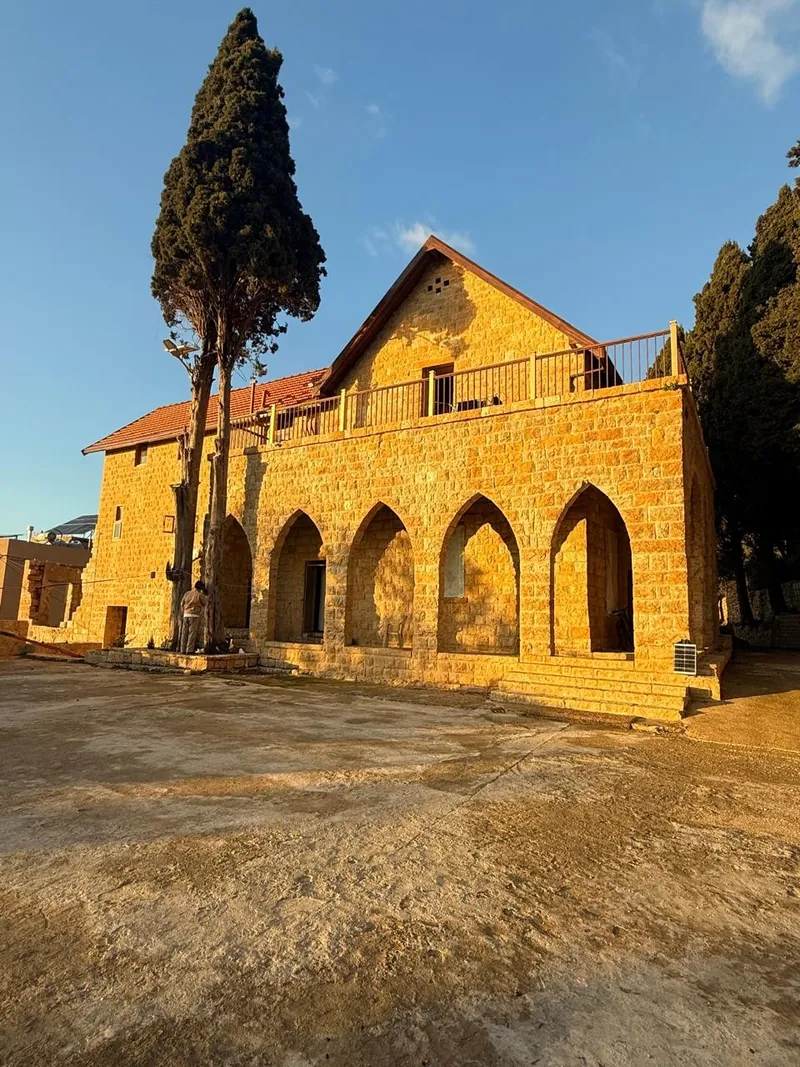
Restored a second time: Qasr Noun
Parfit titled his chapter “A Ruin Restored.” It has now happened twice on this ground.
The same stones have been cleaned, repaired and lit, and the finishing work is under way. The estate that held a deaf Englishwoman's furniture, and then a school, is being readied for a third life: weddings, Katb Kteb and engagements. This is Qasr Noun today.
From the estate, the sun goes down into the sea. For the light and the weather month by month, read a summer evening at the estate. To compare, see other heritage venues in Lebanon. For the drive up, here is where Ain Anub is.