Lebanon's heritage wedding venues are mostly 19th-century palaces and old mountain estates: Mir Amin Palace and Qasr Tabet in the Chouf, the gardens of Sursock Palace in Beirut, Saray Nassib Basha in Sidon, Domaine de Zekrit in the Metn, and Qasr Noun in Ain Anub, Aley. Choose on history, setting, distance from Beirut and what each venue supplies.
We are Qasr Noun, a restored estate in Ain Anub, in the Aley district of Mount Lebanon. This list includes us, and the heritage venues we admire. Each entry links to the venue's public listing, so you can check every line yourself.
Listings checked on 13 October 2026. Venues change their spaces and policies; confirm the details with each one directly.
What makes a wedding venue "heritage"
A heritage venue is a place whose history can be shown, not only described. In practice that means four things.
- Documented history. A date, a builder, a family, or a written account you can read for yourself.
- Original architecture. Stone, arches, courtyards and rooms that were standing before the event business arrived.
- Restoration, not replacement. The old fabric repaired and kept in use, rather than copied in new materials.
- A setting that belongs to the building. A garden, a village or a view that was there long before the dance floor.
A ballroom with a painted ceiling is not a heritage venue. A 19th-century palace that now opens its courtyard for weddings is.
Heritage venues by region
Eight venues, five regions. The "era" column repeats what each venue's listing states; where a listing gives no date, we say so.
| Venue | Region | Era, as stated | Setting | Source |
|---|---|---|---|---|
| Qasr Noun | Ain Anub, Aley | Lintel dated 1895; school from 1907 | Restored estate above Beirut | Parfit, 1917 |
| Mir Amin Palace | Beit ed-Dine, Chouf | 19th-century residence of the emirs | Palace courtyards, pool | Listing |
| Qasr Tabet | Deir el Qamar, Chouf | "Historic architecture", no date given | Hotel with grounds | Listing |
| Bouyouti | Maasser Beiteddine, Chouf | No date given | Gardens, old olive trees | Listing |
| Sursock Palace, The Gardens | Achrafieh, Beirut | Built 1860 | Palace gardens in the city | Listing |
| L'Heritage Venue | Above Nahr el Kalb | No date given | Hotel, hall and pool | Listing |
| Saray Nassib Basha | Bramieh, Sidon | 19th-century Ottoman palace | Gardens over the sea | Listing |
| Domaine de Zekrit | Zekrit, Metn | No date given | Mountain estate | Listing |
Mount Lebanon, Aley district: Qasr Noun, Ain Anub
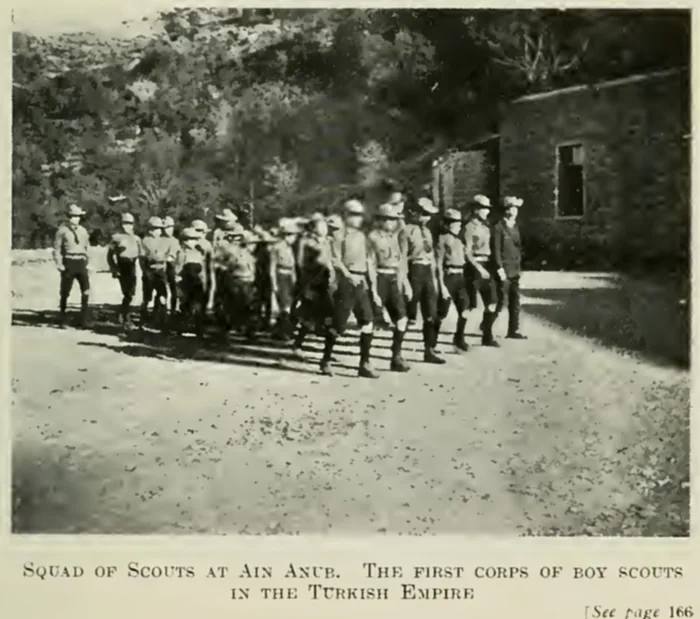
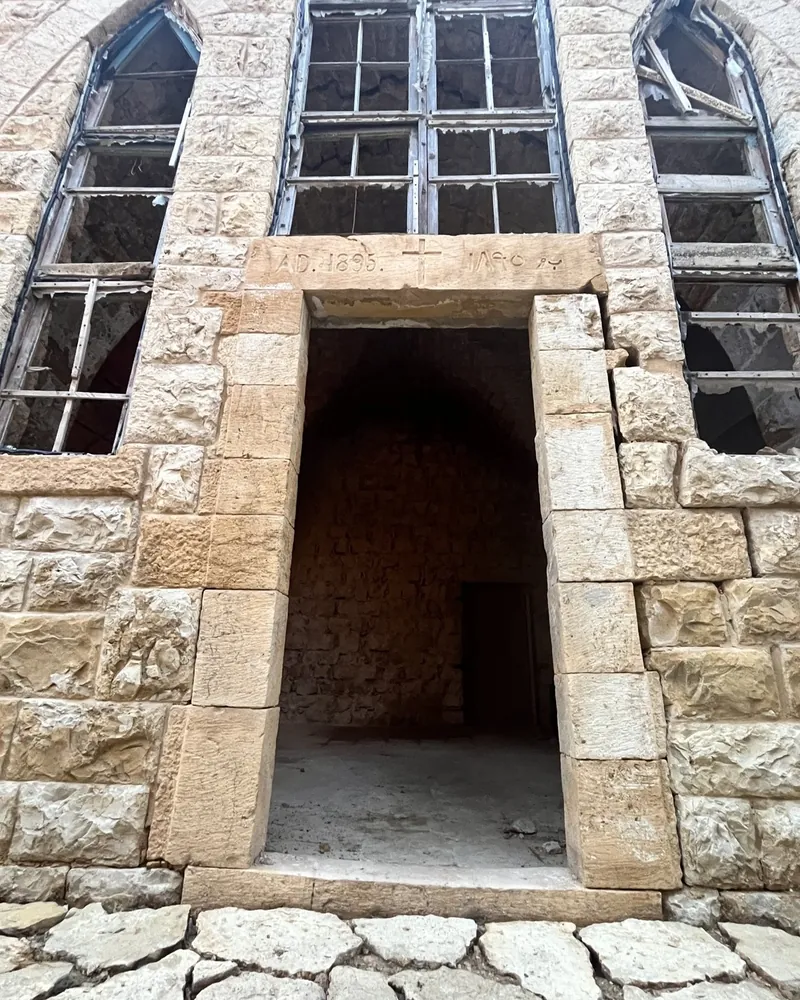
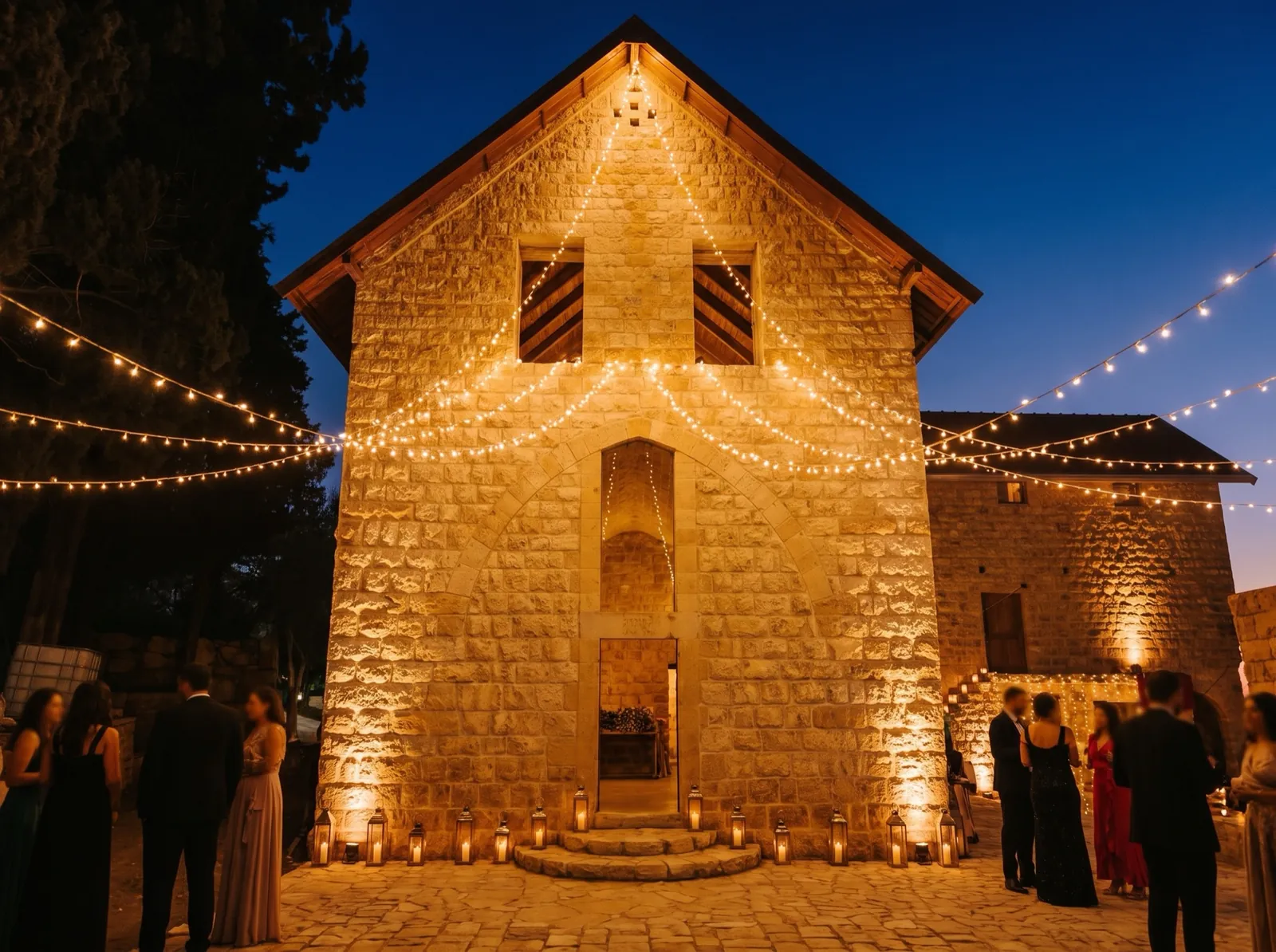
Qasr Noun stands in Ain Anub, a village in the Aley district. A carved lintel over one doorway reads "AD. 1895", with the same year in Arabic numerals. In the autumn of 1907 Canon Joseph T. Parfit took over the neglected buildings and opened a school; by 1914, he wrote, it had "over 150 pupils" (Parfit, 1917). Parfit also recorded its scouts as the first corps of Boy Scouts in the Ottoman Empire. The estate has been restored again and opens for weddings in summer 2027, with private visits by appointment. Read the full story of the Ain Anub school.
Chouf: Mir Amin Palace, Beit ed-Dine
Arabia Weddings describes Mir Amin Palace as "a former residence of the last Emirs of Lebanon in the 19th century" and a national historic landmark, set on the mountainside at Beit ed-Dine (listing). It names four spaces: a pool area, the Al Haramlek Courtyard for up to 150 guests, a Royal Suite courtyard with a central fountain, and an indoor hall, the Serail, suggested for winter weddings. A palace courtyard in summer, with a covered option under the same roof.
Chouf: Qasr Tabet, Deir el Qamar
Qasr Tabet is a hotel on the main road of Deir el Qamar, one of the Chouf's historic stone towns. Its listing speaks of "grand, historic architecture and expansive grounds" and gives no construction date (listing). Part of the appeal is the town itself: guests who arrive early can walk the old streets before the evening begins. The listing does not detail event spaces or guest numbers, so ask the venue for both, along with what it knows of the building's history.
Chouf: Bouyouti, Maasser Beiteddine
Bouyouti, in Maasser Beiteddine, is listed for its gardens and mountain views, with a restaurant space set, in the listing's words, "under ancient olive trees" (listing). It makes no claim to an old building. Its heritage is the landscape: terraces, trees and the Chouf hills. For couples who want an open-air dinner in the mountains rather than a palace, it belongs on the shortlist. The listing gives no capacity; ask how the garden is laid out for a seated dinner.
Beirut and the coast: Sursock Palace, The Gardens
Sursock Palace in Achrafieh was "built in 1860 by Moussa Sursock", according to its listing, and weddings take place in its gardens (listing). It is a heritage venue inside the city: no mountain road, no shuttle, and a short drive for guests staying in Beirut hotels. The listing names one event space, the Gardens, and gives no capacity. Ask early about guest numbers, and about evening sound limits in a residential district.
Beirut and the coast: L'Heritage Venue, Nahr el Kalb
L'Heritage Venue is a hotel "perched above the Nahr El Kalb", north of Beirut (listing). The listing describes "historic grandeur and modern elegance" without giving a date, and lists an indoor hall for up to 600 seated guests, an outdoor pool area for about 700, and 55 rooms. It suits a large wedding where guests stay the night. The valley below is known for its commemorative stelae, carved by passing armies and rulers over many centuries.
South: Saray Nassib Basha, Sidon
Saray Nassib Basha, in Bramieh above Sidon, is listed as a 19th-century Ottoman palace, commissioned by Nassib Basha Joumblat as a winter residence (listing). Its central hall, the listing says, is an 18th-century room moved from the Sham'aya Palace in Damascus, with a fountain carved from a single slab of Carrara marble. The gardens cover 21,000 square metres and overlook the sea and the city. The listing puts it about 35 minutes from Beirut.
Metn: Domaine de Zekrit
Domaine de Zekrit, in Zekrit near Mazraat el Ras, is listed as "a grand, exclusive Lebanese mountain escape" (listing). The listing gives no history and no capacity. It reads as a mountain estate rather than a documented monument, and it allows outside vendors, which matters if you already have a caterer or planner in mind. Visit before you shortlist, and ask what the buildings were before they hosted weddings.
Courtyard, garden or estate: choosing the setting for your guest list
Heritage venues come in three shapes. Each suits a different wedding.
The courtyard. Walls on four sides, stone underfoot, sound held in. Right for a katb kteb, an engagement, or a dinner where everyone should hear the speeches. Ask whether dinner and dancing fit at the same time, or whether the space must be turned around mid-evening.
The garden. Room for long tables, a separate cocktail area and a dance floor at a distance from dinner. It depends on the weather and on light after dark. Ask where the paths are lit, and where the dance floor goes if the lawn is soft.
The whole estate. Several spaces in sequence: ceremony, cocktail, dinner, late night. Guests move with the evening. Ask about walking distances, steps for older guests, and lighting on every route between spaces.
One rule for all three: count the guests you will seat, not the guests you will invite. Ask each venue for its seated-dinner number with the dance floor in place. Standing capacity is a different, larger figure.
Questions to ask a heritage venue before you book
Old buildings were not designed for 200 guests and a sound system. These are the questions that matter in Lebanon, and the ones a good venue answers without hesitating.
- Power. What generator runs the night, at what capacity in kVA, for how many hours, with what backup? Lighting, sound, kitchen and effects all draw from it.
- Parking and traffic. How many cars fit on site? Is there valet? Who coordinates with the municipality for traffic on the access road?
- Restrooms. How many, permanent or portable, and lit on the way there? Older guests will ask.
- Noise curfew. When must the music stop? Is that the venue's rule or the municipality's? Is a late-night extension possible, and where?
- Rain plan. What is the covered space, who pays for a tent, and by what date do you decide? Summer is dry; May and October are not.
- Restoration status. What is finished today, and what will be finished by your date? Visit in person and ask for recent, dated photographs.
- Photography rights. Can your photographer fly a drone? Can the venue use your photos, and only with your consent?
- Heritage rules. Candles near old wood, cold sparks, fireworks, confetti, and anything fixed to old stone. Ask what is allowed before your planner designs around it.
- Suppliers. Is there an exclusive caterer or sound list? Are outside vendors allowed, and on what terms?
- The road at night. Where do shuttles drop guests, and is the way down lit?
- The history. What does it rest on: a date stone, a book, a family archive? A venue proud of its past will show you.
Why the mountain
The difference is the evening. Across 2015 to 2024, the average July low at Ain Anub was 20.2 °C, against 24.4 °C in central Beirut, according to Open-Meteo historical reanalysis. Daytime highs differ by little more than a degree. The gap opens after sunset, which is when a wedding happens.
June to September is close to rain-free in the hills. Late May and early October bring milder days and a real chance of rain. For month-by-month figures and sunset times, see the best months for an outdoor wedding.
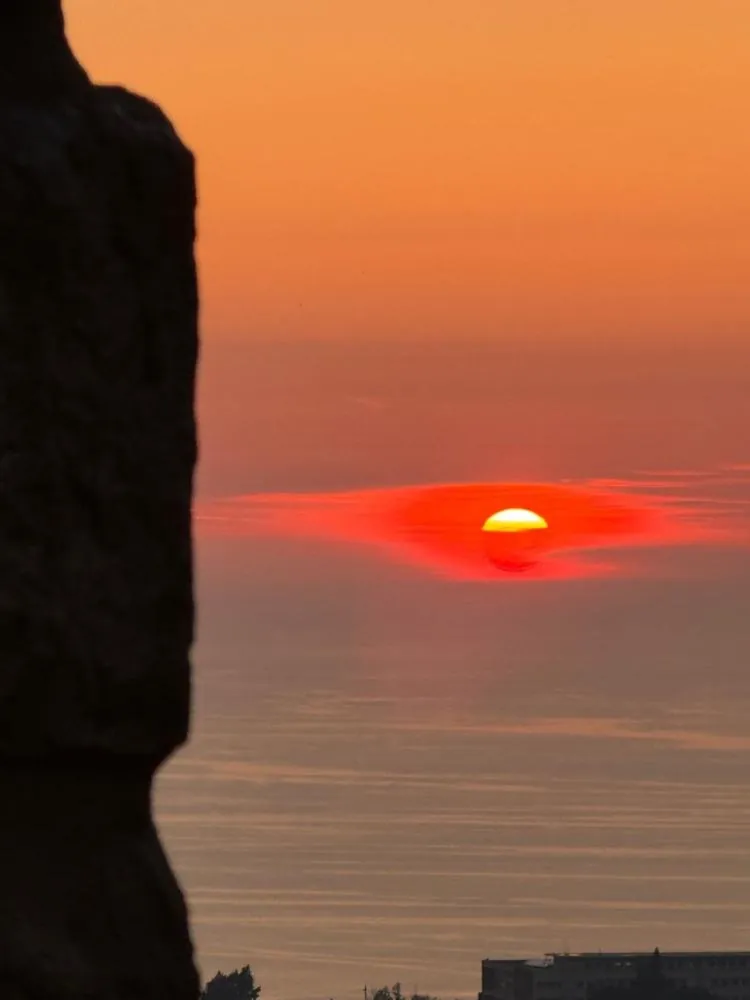
Then there is the view. In 1917 Parfit described Ain Anub as "nearly 2000 feet high, on the Lebanon hills, overlooking the city of Beyrout and the Mediterranean Sea" (Parfit, 1917). From the western slopes, the sun goes down over the water. Mountain venues ask more of guests in return: a drive, a shuttle, a plan for the way home. Check how far Ain Anub is from Beirut, and budget for the extras a hillside venue needs with our guide to what a Lebanese wedding costs in 2027.
Shortlist with your own eyes
Every venue on this list deserves a visit at the hour your wedding will happen. Stand where dinner will be. Watch where the light falls. Ask the eleven questions.
If Qasr Noun is on your list, call or WhatsApp +961 3 697 772 for a private visit.