Lebanese wedding traditions include the religious ceremony or Katb Kteb, the zaffe procession of drummers and dancers that brings the couple in, dabke danced in a long line, the women's zalghouta, the cake cut with a sword, and dragées for every guest. At Qasr Noun in Ain Anub, each has its place on the estate.
Lebanon recognises 18 religious communities, each with its own family law (Wikipedia), and customs differ from one family to the next. This guide covers the traditions that come up most often in Lebanese wedding planning, names a community only where a source does, and shows how each one plays out on an estate like Qasr Noun. The estate images are styled visualisations: the architecture is real, the weddings are rendered.
The ceremony comes first, and separately
In Lebanon, marriage is a religious act. Lebanon has no civil code for marriage, and each person marries under the family law of their own community (Wikipedia). Many couples who want a civil ceremony travel to neighbouring Cyprus, because Lebanon recognises civil unions registered abroad (Arab News, 2019).
The rite belongs to the couple's own faith. The wedding night, with its zaffe, dinner and dancing, is the celebration, and that is what a venue hosts.
The Katb Kteb (katb kitab): writing the contract
Katb Kteb, also written katb kitab or katb el-kitab (كتب الكتاب), means "writing the book": the signing of the Islamic marriage contract. A SeekersGuidance answer describes it as "a legal written marriage contract ceremony which is done in the Levant", valid once an offer and an acceptance are made before two witnesses (SeekersGuidance). In Islamic practice the contract, the nikah, is typically followed by a celebratory reception (Wikipedia: Nikah). Ask your officiant what the signing needs: who must be present, which documents, and how long it takes.
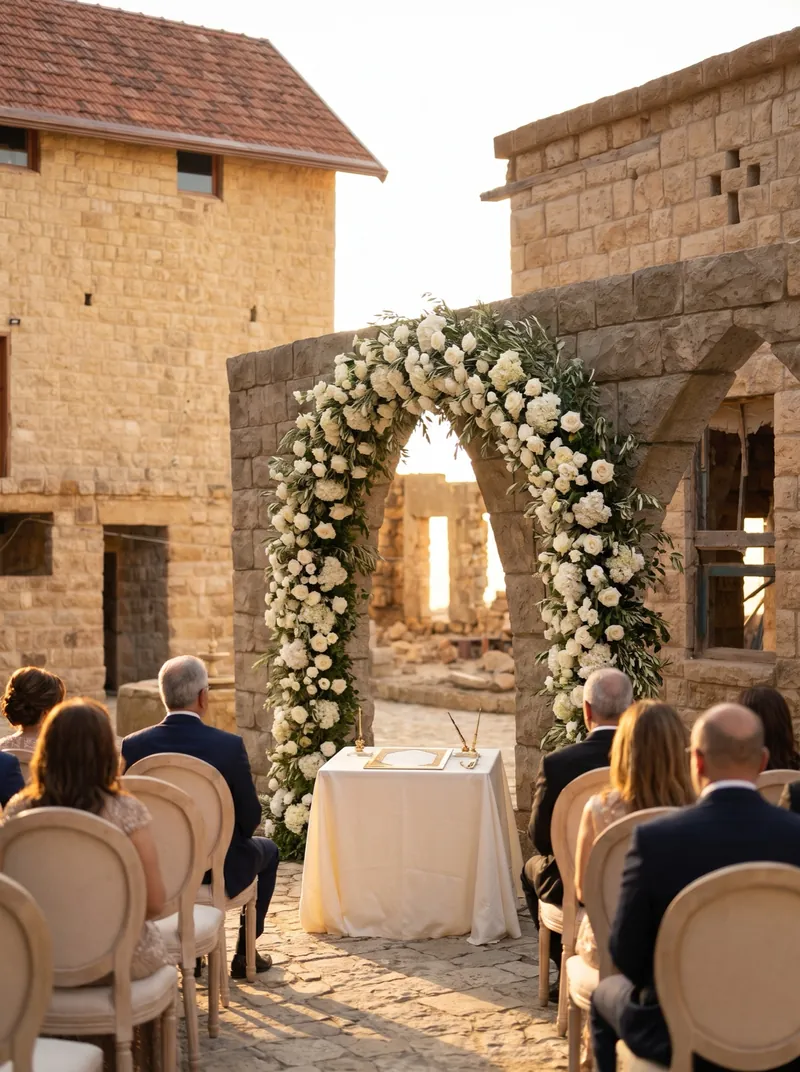
At Qasr Noun, the fountain courtyard is made for it: close and quiet. For the venue side, read a Katb Kteb venue in Lebanon.
The Lebanese zaffe
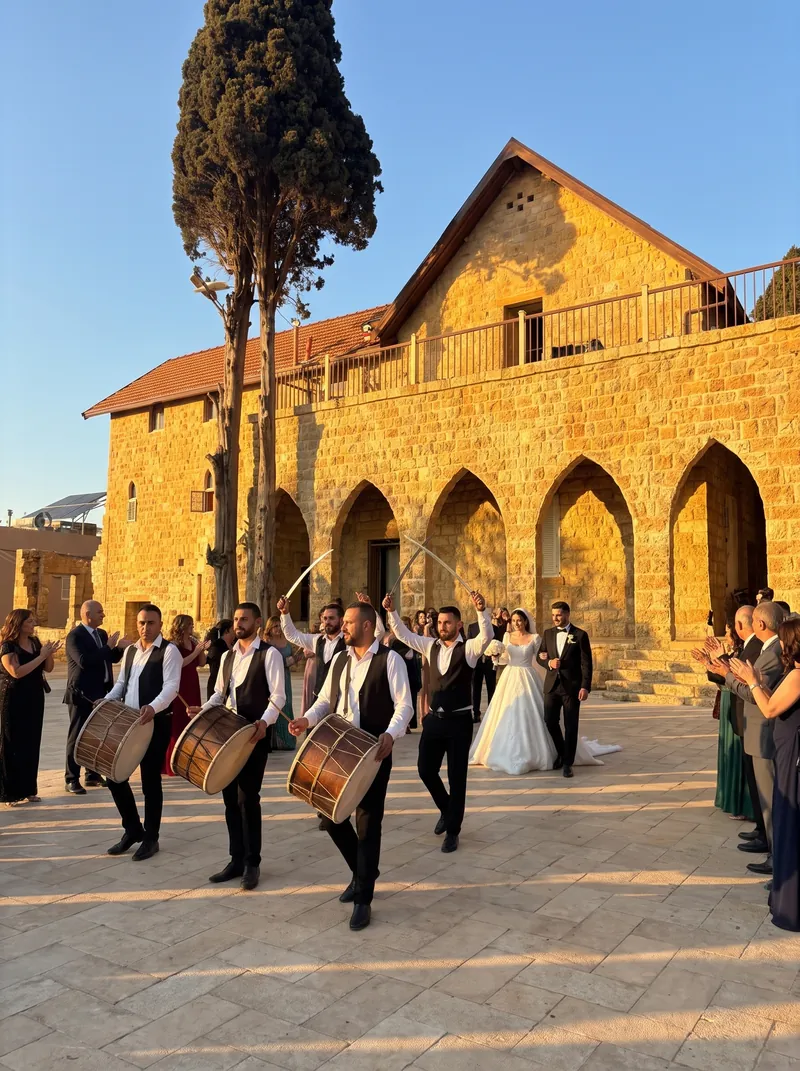
The zaffa is a wedding procession found, in many regional forms, across the Arab world (Wikipedia: Zaffa). In Lebanon, writes Arabia Weddings, "the night almost always opens with the Zaffe": a march with "a large troupe of drummers playing the Derbake, musicians, and dancers in coordinated costumes", and the couple's grand entrance (Arabia Weddings). A Lebanese-American student interviewed for the USC Digital Folklore Archives named the tabl drum, the darbuka and a flute, the zamour, as essential at the Lebanese weddings she had attended (USC, 2023).
Where the zaffe begins differs. A Lebanese woman interviewed for the same archive described a custom "mostly practised by the Druze": a zaffe from the groom's home to the bride's, with a band and dancers in traditional Druze dress. "The groom and family must dance and sing until they reach the bride to claim her from her parents" (USC, 2023).
Choreography, songs and timing are usually settled one to two months ahead, according to Arabia Weddings. Ask the troupe how many drummers and dancers come, and for how many minutes. A zaffe carries best after dark, when lights and sparks catch, so plan it around the sunset in your month. At Qasr Noun, it can cross the courtyard and bring the couple in under the five pointed arches of the arcade.
Dabke at weddings
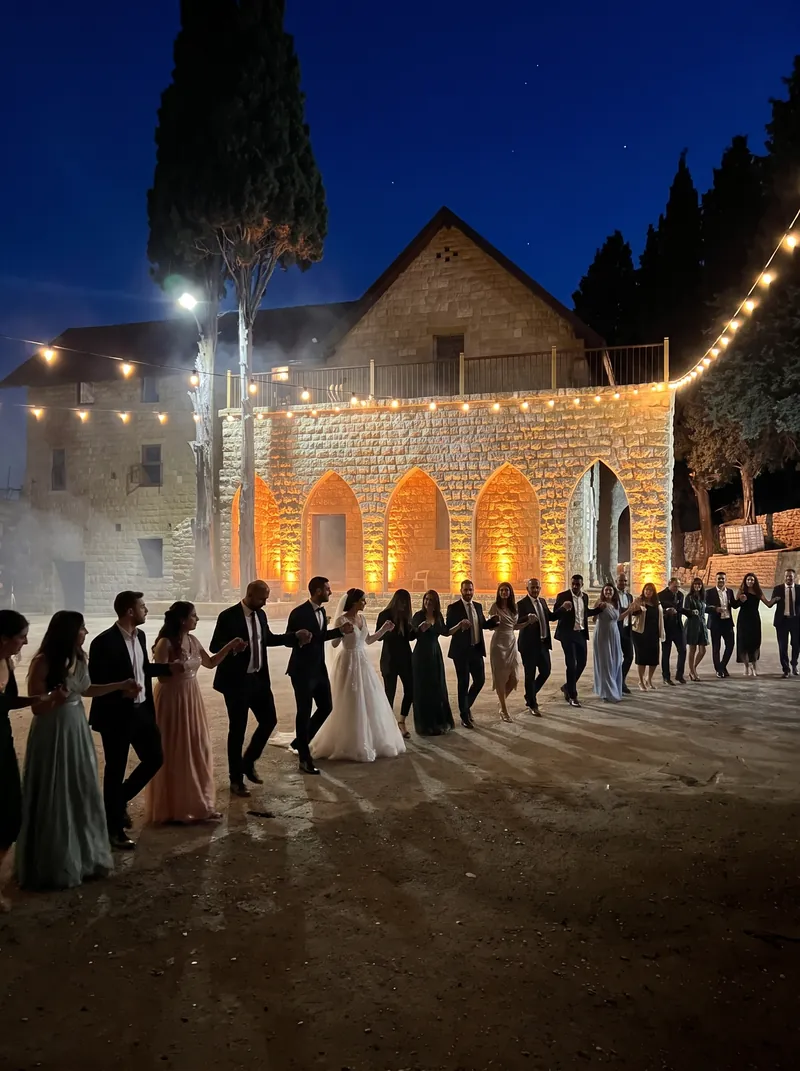
Dabke is a Levantine folk dance that combines circle and line dancing. It is popular among Lebanese, Jordanian, Palestinian and Syrian communities and "widely performed at weddings and other joyous occasions" (Wikipedia: Dabke). The name is thought to come from dabaka, "stamping of the feet". Dancers hold hands, the line forms from right to left, and the leader heads it. The music leans on the mijwiz, a reed clarinet, and the tablah, a hand drum also called the durbakke.
Late in the night, Arabia Weddings notes, a DJ "steps in to drive the after-party", mixing international tracks with Levantine line dances "like the Dabke". For the venue, dabke asks for one thing: a long, open floor for a line that keeps growing. At Qasr Noun it goes under the arches, with sound and lighting in the package and the night running until 1:30 AM.
The zalghouta
Lebanon Traveler describes the zalghouta, also called zaghroota, as "a high-pitched tongue trill". What sets the Lebanese form apart, it says, is that "there are a few verses chanted before the loud cry"; at weddings, the verses usually compliment the bride and groom. Women mainly perform it, and the words are often improvised for the occasion (Lebanon Traveler, 2020). SBS calls it a cry "uttered by little girls, mothers, grandmothers and aunties" (SBS, 2020). There is nothing to book. Leave a pause for it.
The first dance, the sparks and the cake cut with a sword
Arabia Weddings calls the cake cutting "a major focal point of a Lebanese wedding reception", and the ceremonial sword "a dramatic staple of Lebanese cake cuttings", often with sparklers, fireworks or a zaffeh. Many couples cut a tall faux gâteau, a dummy cake of styrofoam covered in sugar paste with a real slice hidden inside for the photographs, while guests are served from a sheet cake kept in the kitchen (Arabia Weddings). Ask your baker whether the sword comes with the cake, or whether your caterer must supply it. We found no reliable source for where the sword custom began, so we will not guess.
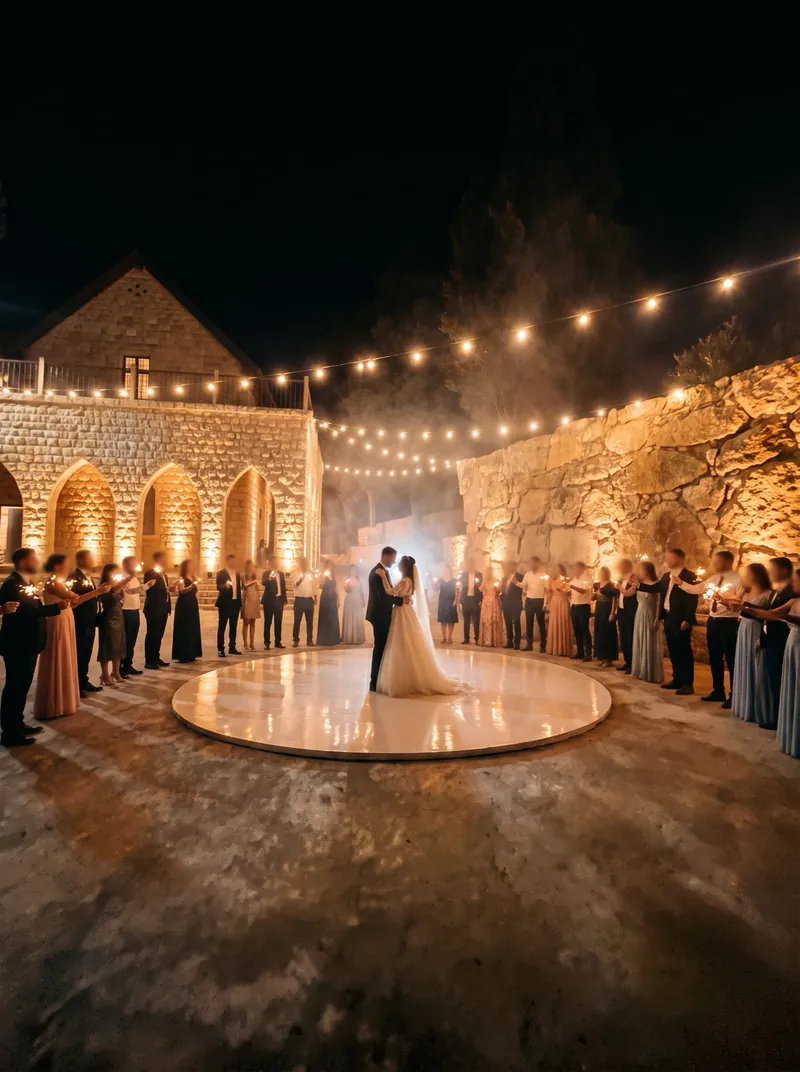
At Qasr Noun, dry ice and cold-spark volcanoes are part of the full package, for a first dance or a cake cutting. At any heritage venue, ask which effects are allowed near old stone and wood.
Lebanese wedding dragées and souvenirs
Lebanese wedding favours are called "souvenirs", and local tradition, says Arabia Weddings, "strongly dictates attaching a small bundle of three to five sugared almonds" to each one. The almonds go by their French name, dragées, or in Arabic, mlabas. Souvenirs with chocolate are usually assembled one to two weeks before the wedding and kept from melting (Arabia Weddings). Elsewhere, sugared almonds given as wedding favours are often packed in fives, for happiness, health, longevity, wealth and fertility (Wikipedia: Dragée). For the chocolate on the bride's table, see the published prices in our guide to Lebanese wedding costs.
Planning the night around the traditions
| Tradition | What to arrange | A place for it at Qasr Noun |
|---|---|---|
| Katb Kteb | Officiant, two witnesses, documents | The fountain courtyard |
| Zaffe | Troupe size, minutes, route; settle one to two months ahead | In by the lantern lane, across the courtyard to the arcade |
| First dance | Which effects are allowed | The courtyard; cold-spark volcanoes and dry ice included |
| Dabke | A long, open floor; sound until late | Under the arches, until 1:30 AM |
| Cake and sword | Who brings the sword; a real slice in the faux gâteau | By the tower, lit until the last song |
| Dragées | Souvenirs assembled one to two weeks ahead, kept cool | Tell us where you want them |
The places above are suggestions for the estate's spaces, as named on our homepage. Every family arranges its night differently.
One estate, from the engagement to the last dabke
Some families begin months earlier, with an engagement. At Qasr Noun, engagements belong under the olive tree in the afternoon light, the Katb Kteb in the fountain courtyard, and the wedding under the arcade until 1:30 AM. Read about engagement parties at the estate and weddings at Qasr Noun, and if family is flying in, a destination wedding in Lebanon. Before you book anywhere, take our venue checklist. Private visits are by appointment, any day.